Evaluating the Mask Japanese Traditional Stamp Brush for Digital Tattoo Design
In the realm of digital tattoo illustration, efficiency and authenticity often compete with one another. Artists frequently seek tools that can replicate the organic texture of traditional ink without sacrificing the speed required for modern workflows. The Mask Japanese Traditional Stamp Brush emerges as a specialized resource designed to bridge this gap, specifically targeting those who wish to incorporate Ukiyo-e aesthetics into their digital portfolios. However, before integrating any new tool into a professional pipeline, it is essential to understand its specific mechanics, limitations, and how it stacks up against other available resources. This analysis aims to provide a clear, practical overview to help you determine if this brush set aligns with your artistic goals.
Understanding the Core Functionality
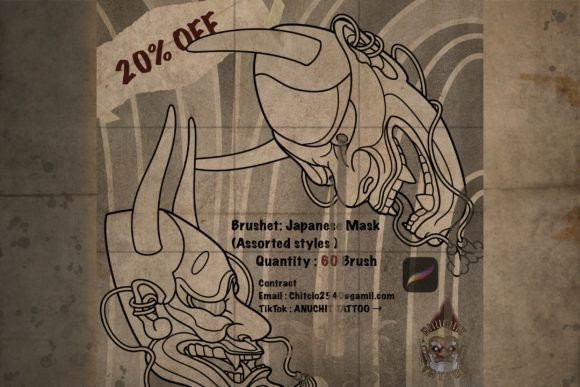
The Mask Japanese Traditional Stamp Brush is not merely a collection of generic strokes; it is a curated Procreate brush set engineered to mimic the intricate line work found in traditional Japanese art. Crafted by an artist with deep expertise in Edo period aesthetics, the brushes are built upon the principles of Ukiyo-e, a style renowned for its bold outlines, dynamic movement, and distinct textural qualities. Unlike standard calligraphy brushes that rely heavily on pressure sensitivity to create variable line widths, this set utilizes stamp-based logic combined with masking techniques to generate consistent, repeatable patterns that resemble hand-carved woodblock prints.
The primary distinction of this tool lies in its ability to render complex details quickly. In traditional tattoo design, artists spend hours sketching fine lines for scales, waves, or floral motifs. With the Mask Japanese Traditional Stamp Brush, these elements can be constructed with significantly less manual effort while retaining the visual weight of hand-drawn art. The "mask" aspect refers to the way the brush interacts with layers, allowing for non-destructive editing and precise placement of textures. This feature is particularly valuable when refining a design, as it permits the artist to adjust opacity, position, and blending modes without altering the underlying stroke data.
Key Technical Characteristics
- Texture Fidelity: The brushes capture the grain and imperfection of traditional paper and ink, avoiding the sterile look of vector paths.
- Pattern Consistency: Ideal for repetitive elements like fish scales or cloud formations, ensuring uniformity across large designs.
- Layer Integration: Designed to work seamlessly within Procreate's layer system, supporting clipping masks and blend modes for complex shading.
- Aesthetic Specificity: Strictly adheres to the stylistic rules of Japanese traditional tattooing (Irezumi), making it unsuitable for Western realism or geometric styles.
Comparing Approaches: Stamps vs. Freehand Brushes
When evaluating digital tools for tattoo design, the choice often comes down to the method of creation: freehand drawing versus asset-based stamping. Standard calligraphy brushes offer maximum freedom, allowing the artist to dictate every curve and taper based on finger pressure and tilt. This approach is superior for custom, fluid lines where no two strokes should ever be identical. However, it demands a high level of technical skill and time investment to achieve the density and precision seen in traditional Japanese pieces.
In contrast, the Mask Japanese Traditional Stamp Brush operates on a hybrid model. It provides pre-defined shapes and textures that can be placed and manipulated. While some may argue that this reduces the "human touch," proponents suggest it actually enhances the workflow by allowing the artist to focus on composition rather than execution. For instance, creating a dragon scale pattern freehand might take twenty minutes, whereas using the stamp brush could reduce that to two minutes. The tradeoff is that overuse of stamps can lead to a repetitive appearance if the artist does not vary rotation, size, and opacity sufficiently.
Compared to vector-based design tools, which produce clean, scalable lines but lack organic texture, this brush set offers a middle ground. It retains the softness of traditional media while providing the editability of digital formats. When compared to generic watercolor or ink brushes available in default app libraries, the Mask Japanese Traditional Stamp Brush stands out due to its cultural specificity. Generic brushes may simulate ink flow, but they rarely capture the specific structural integrity of Ukiyo-e line work, which requires a balance of rigidity and fluidity unique to the genre.
Strengths and Tradeoffs in Professional Workflows
The primary strength of this resource is its capacity to accelerate the design phase without compromising the final aesthetic. For tattoo artists managing a busy schedule, the ability to rapidly prototype Japanese-style concepts is a significant advantage. The detailed lines filled with artistry and diversity make this set an excellent resource for those looking to emphasize their tattoos with authentic flair. It allows designers to experiment with different compositions—such as shifting the placement of a koi fish or adjusting the density of background clouds—with minimal friction.
However, there are notable tradeoffs to consider. The reliance on stamped elements means that the artist must possess a strong understanding of composition to avoid a "sticker-like" appearance. If the strokes are placed too uniformly, the design may lose the spontaneity that characterizes great traditional art. Additionally, because the brushes are optimized for a specific style, they are less versatile for other genres. An artist specializing in blackwork or dotwork will find limited utility in this set compared to someone focused exclusively on Irezumi.
Another consideration is the learning curve associated with mastering the mask functionality. While the brushes are user-friendly, leveraging them to their full potential requires familiarity with Procreate's advanced features, such as alpha locks and layer masks. Beginners might initially struggle to integrate these textures naturally, potentially resulting in designs that look disjointed until they develop a better sense of spacing and variation.
Determining the Right Fit for Your Needs
Deciding whether the Mask Japanese Traditional Stamp Brush is the right choice depends largely on your current workflow and artistic objectives. If you are an experienced tattoo artist looking to expand your repertoire into Japanese traditional styles, this tool can serve as a powerful accelerator. It is particularly well-suited for clients who desire specific traditional motifs—like peonies, tigers, or waves—but require rapid turnaround times for consultations and stencils.
Conversely, if your practice focuses on hyper-realism, lettering, or abstract geometry, this brush set may not offer sufficient value. In these cases, investing in high-fidelity freehand brushes or vector software would likely yield better results. Furthermore, if you prefer the tactile sensation of drawing every single line from scratch and view the process as meditative, the efficiency of stamp brushes might feel counterintuitive to your creative process.
It is also important to consider the context of your client interactions. Some clients appreciate seeing a design that feels entirely hand-drawn, valuing the perceived effort in every stroke. In such scenarios, relying too heavily on pre-made assets might require careful explanation during the consultation process. Transparency about the use of digital aids to enhance accuracy and detail can mitigate concerns, provided the final result remains unique to the client.
Practical Decision Factors
- Style Alignment: Does your portfolio primarily feature Japanese traditional or neo-traditional styles?
- Time Constraints: Do you need to produce multiple design variations quickly for client approval?
- Skill Level: Are you comfortable manipulating digital masks and layer properties to customize stamp effects?
- Client Expectations: Is your clientele more concerned with the final visual outcome or the methodology used to create it?
Final Considerations Before Purchase
While the Mask Japanese Traditional Stamp Brush offers compelling benefits for specific applications, it is not a universal solution for all digital artists. Its value is derived from its specialization in Edo period aesthetics and its ability to streamline the creation of intricate patterns. Embracing the essence of these historical styles can elevate the artistry of your creations, but only if the tool is used with intention and skill.
As with any digital asset, the quality of the output is ultimately dependent on the artist's vision. The brushes provide the raw materials, but the composition, color theory, and narrative depth must still come from the creator. Therefore, we strongly advise you to thoroughly review product details before making any purchase to avoid any potential inconvenience. Ensure that the file format is compatible with your version of Procreate, check for sample images that demonstrate the range of included textures, and verify that the licensing terms allow for commercial use in tattoo stencils.
By weighing the strengths of accelerated production against the need for manual customization, you can make an informed decision that supports your artistic growth. Whether you choose to adopt this tool or continue with traditional freehand methods, the goal remains the same: to create meaningful, high-quality tattoo designs that resonate with your clients. Thank you for your interest and cooperation in exploring these digital resources thoughtfully.